
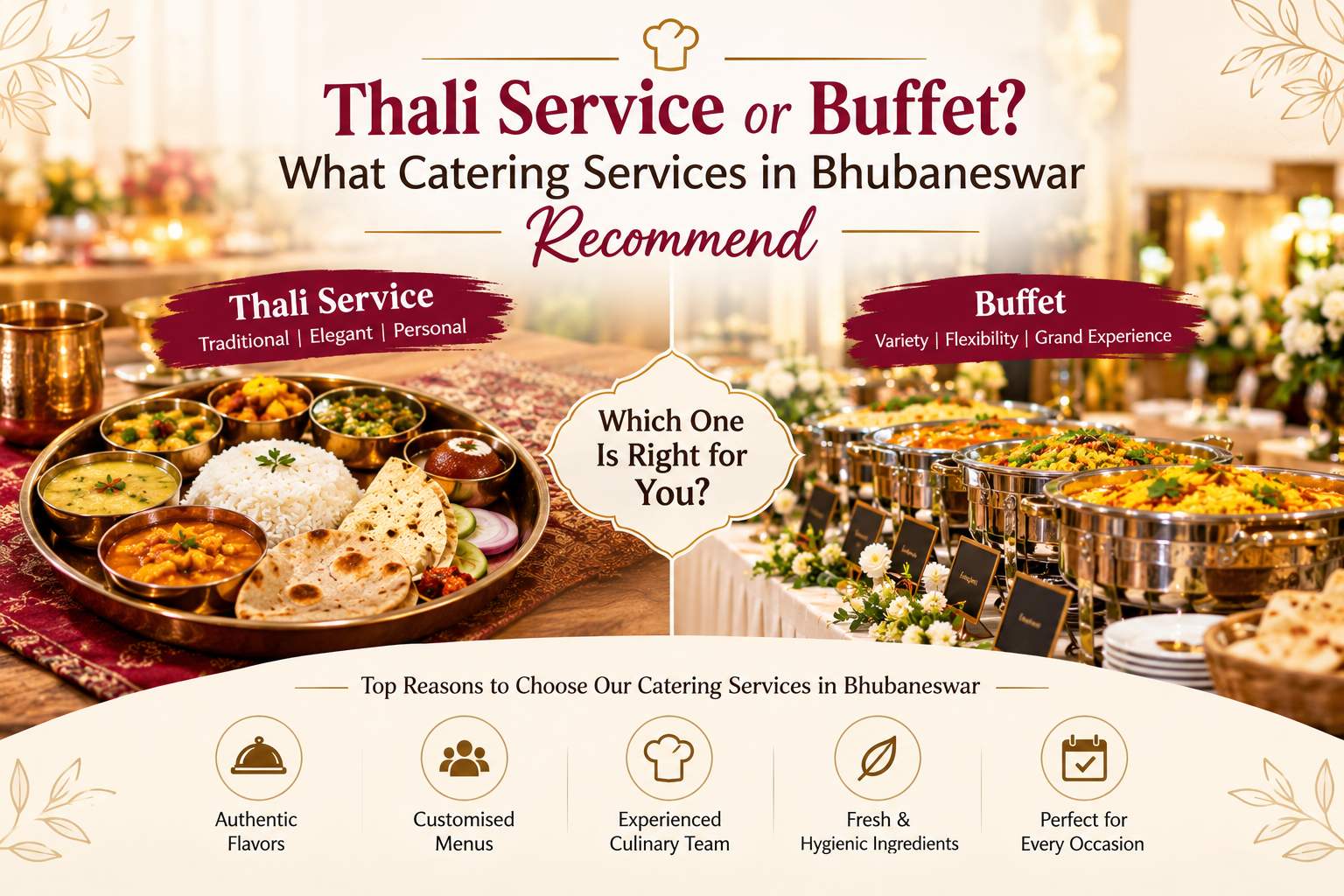
Thali Service or Buffet? What Catering Services in Bhubaneswar Recommend
Ask any host planning a meal for guests and you will hear the same debate: should we serve a thali or set up a buffet? Both are popular across Odisha, and both can be done well or badly. The right choice depends on your guests, your space and the mood of your event. Having seen many events across the city, catering services in Bhubaneswar tend to give the same advice, which is that there is no universal answer, only a good fit.
This guide lays out the real differences so you can decide for your own gathering.
What thali service looks like
In a thali service, each guest is served a complete meal on a plate or leaf, usually seated, with waiters bringing and refilling dishes. The meal arrives in a thoughtful order, and guests are attended to individually. It is a traditional approach that suits ritual meals, family gatherings and smaller events where the personal touch matters.
The advantages are clear. Guests are comfortable, elders are looked after, and nobody has to stand in a queue with a plate. Portions are better controlled, which can reduce waste. The atmosphere tends to be calm and respectful.
What a buffet offers
A buffet places the dishes on long tables or counters and invites guests to serve themselves. It is the common choice for weddings, receptions and large parties, where hundreds of people need to eat within a limited time. Guests can choose what they want, return for seconds and move around freely, which suits celebrations where people want to mingle.
A buffet also allows more variety. Where a thali has a fixed set of dishes, a buffet can offer many items, including live counters, without crowding a single plate.
The drawbacks worth admitting
Thali service needs more staff. Every table must be attended to, which means a larger team and more careful coordination. It also takes longer to serve a large crowd, and it requires seating for everyone at once or in batches, which can be difficult in a limited space.
Buffets, on the other hand, can create queues, especially if there are only one or two serving points. Elderly guests and young children may struggle to carry plates and juggle dishes. Some guests take more than they can finish, which can increase waste, and food on the counters can cool if refills are not managed well.
How guest count shapes the decision
For gatherings under about a hundred people, thali service is often practical and charming. As numbers rise, buffets gain the advantage, because serving hundreds of individual thalis quickly requires a large and well-drilled team. At very large events, thousands of guests may be served through multiple counters at once. Sumangalam Caterers has handled events from fifty guests up to ten thousand since 2010, and the service style changes dramatically across that range.
Space and seating matter
Think about your venue. A thali meal needs tables, mats or chairs arranged so that waiters can move freely. A buffet needs room for counters and for guests to queue without blocking pathways. At home, a thali meal may be easier. In a banquet hall or lawn, a buffet generally fits better. Ask your caterer to visit the venue if you are unsure.
Think about who is coming
Consider the ages and habits of your guests. If many elderly relatives will attend, you might serve them thali-style at a separate table while others use the buffet. If you are hosting a ceremony where guests eat in batches, a thali may keep the rhythm of the ritual intact. For a party with lots of young people, a buffet and live counters feel more fun.
The hybrid solution
Many hosts combine the two. Seated service for the main meal, followed by a dessert counter or a chaat station, keeps the sense of care while adding variety. Another option is a buffet for starters and a thali-style main course. Catering services in Bhubaneswar are usually happy to design such combinations if you explain what you have in mind.
Questions to ask your caterer
How many staff will you assign to serve the number of guests I expect? How many counters will be set up? How will you keep food hot and replenished? What happens if guests arrive in a rush? How do you manage elders and children? The answers reveal how well the team has planned.
Making a confident choice
Do not decide based on what is fashionable. Decide based on who your guests are and how you want them to feel. A thali says, “You are being looked after.” A buffet says, “Enjoy yourself and take what you like.” Both are generous in their own way.
A few practical tips whichever style you pick
What guests actually remember
In the end, guests rarely remember the service style itself. They remember whether they were comfortable, whether the food was hot and whether they were treated with courtesy. A well-run buffet can feel warm, and a poorly run thali service can feel chaotic. Quality of execution matters more than the format. When you speak with catering services in Bhubaneswar, ask to hear about events similar to yours and how they managed the flow. Their stories will tell you more than any menu card.
One more consideration: cleanup and sustainability
Think about what happens after the meal. Thali service on steel plates or leaves creates a different cleanup task from a buffet on disposable or ceramic plates. Ask how used plates will be cleared, who will wash them and how waste will be handled. A caterer who plans for this quietly protects both your venue and your peace of mind.
If you choose thali service, brief the waiters to refill dishes before guests have to ask. If you choose a buffet, place plates at the start, cutlery at the end and desserts on a separate table to avoid crowding. Whichever style suits you, leave space for elderly guests to sit comfortably, and keep drinking water within easy reach. Experienced catering services in Bhubaneswar plan these details quietly so that you never have to think about them on the day.
